If you're researching treatment options for a liver tumor, you've likely come across the term Y-90 radioembolization. It can sound intimidating at first, but Y-90 is actually a well-established, minimally invasive procedure that interventional radiologists use to treat certain liver tumors directly, often without the need for major surgery.
Patients exploring liver tumor treatment in St. Louis frequently ask their doctors whether they're candidates for this type of therapy, and how it compares to other options like surgery, chemotherapy, or ablation. At STL IOIR Clinics, our interventional radiology team offers Y-90 radioembolization as part of a broader range of liver-directed therapies, tailored to each patient's specific diagnosis and overall health.
This article walks through what Y-90 treatment involves, who it may help, and what to expect before, during, and after the procedure.
What Is Y-90 Radioembolization?
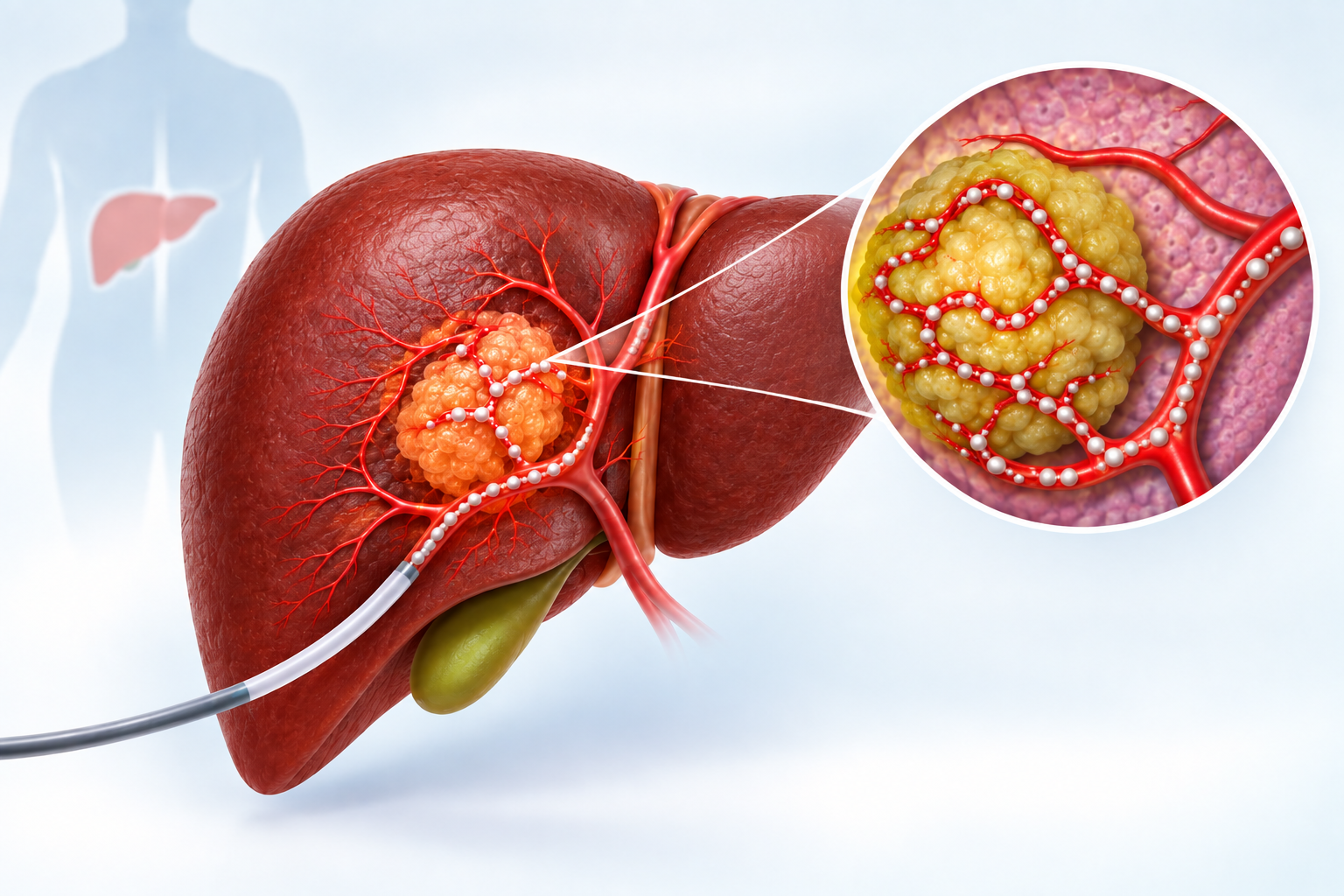
Y-90 radioembolization (also called Y-90 therapy or radioembolization for liver cancer) is a targeted treatment that delivers radiation directly to a liver tumor while sparing much of the surrounding healthy liver tissue. The "Y-90" refers to Yttrium-90, a radioactive isotope that is loaded onto tiny beads known as microspheres.
Here's the basic idea: instead of radiation coming from an external source and passing through the body, Y-90 radioembolization places the radiation source inside the tumor's blood supply. This is possible because liver tumors typically draw most of their blood supply from the hepatic artery, while normal liver tissue relies more on a different blood vessel. This distinction allows interventional radiologists to direct treatment toward the tumor with more precision.
The procedure itself falls under interventional oncology, a field of medicine that uses imaging guidance, such as X-ray or fluoroscopy, to perform minimally invasive procedures through small catheters rather than large surgical incisions.
How Does Y-90 Treatment Work?
Y-90 radioembolization is typically carried out in two stages, spread across a few weeks.
- Initial evaluation. Your care team reviews your imaging, tumor characteristics, liver function, and overall health to determine whether Y-90 radioembolization may be appropriate for your situation.
- Treatment planning and mapping. Before the actual Y-90 treatment, patients usually undergo a mapping procedure. A catheter is guided through the blood vessels leading to the liver, and a small amount of a mapping agent is used to study blood flow patterns. This step helps the physician calculate an appropriate treatment plan and identify any vessels that need to be addressed beforehand to protect nearby organs.
- Delivery of Y-90 microspheres. During the actual treatment, a catheter is threaded through the femoral or radial artery and guided into the hepatic artery under imaging guidance. The Y-90-loaded microspheres are then released into the blood vessels feeding the tumor, where they lodge in place and deliver radiation over the following days.
- Follow-up and monitoring. After treatment, patients are monitored with follow-up appointments and imaging to assess the tumor's response and check liver function over time.
Who May Be a Candidate for Y-90?
Candidacy for Y-90 radioembolization depends on several individual factors, and only a qualified physician can determine whether it's the right option for a specific patient. Generally, physicians consider things such as:
- The size, number, and location of liver tumors
- Whether the cancer has spread beyond the liver
- Overall liver function and health
- Blood flow patterns within the liver
- Prior treatments the patient has undergone
Because every case is different, a thorough evaluation, including imaging and lab work, is an essential first step before any decision is made.
What Conditions Can Y-90 Treat?
Y-90 radioembolization may be considered for certain primary liver tumors, meaning cancer that originated in the liver itself, such as hepatocellular carcinoma. It may also be considered for certain metastatic liver tumors, which occur when cancer from another part of the body, such as the colon, has spread to the liver.
For metastatic liver tumors, Y-90 is often used in conjunction with chemotherapy prescribed by the patient's medical oncologist. In these cases, patients typically take a brief pause from chemotherapy around the time of Y-90 treatment, sometimes called a chemo holiday, before resuming their systemic treatment plan.
For hepatocellular carcinoma and other primary liver tumors, Y-90 may be considered a curative treatment option in appropriate cases, with tumors smaller than 3 cm often the best candidates for a curative outcome. Y-90 can also be used to downstage larger tumors, shrinking them to help a patient become eligible for liver transplant, serving as a bridge to transplant. These cases are typically reviewed in conjunction with a multidisciplinary liver transplant team and presented at a tumor board to determine the most appropriate treatment path.
The appropriateness of Y-90 liver cancer treatment depends heavily on the specific tumor type, its extent, and the patient's broader treatment history, which is why this therapy is typically discussed as part of a larger, individualized treatment plan developed with an oncology team as one of several liver cancer conditions we treat.
What Are the Potential Benefits of Y-90?
While outcomes vary from patient to patient, Y-90 radioembolization for liver tumors offers some general potential advantages worth discussing with your physician:
- It is a minimally invasive, catheter-based procedure rather than open surgery
- It allows radiation to be directed more precisely at the tumor's blood supply
- Recovery time is often shorter compared to more invasive surgical procedures
- It may be an option for some patients who aren't candidates for surgical resection
- For select smaller primary liver tumors, Y-90 may be considered a curative treatment option
- It may help downstage larger tumors as a bridge to liver transplant, in coordination with a multidisciplinary liver transplant team and tumor board
Depending on your diagnosis, your care team may also discuss it alongside other liver-directed therapies like TACE to determine which approach, or combination of approaches, best fits your situation.
As with any medical treatment, individual results depend on many factors, and Y-90 is not a guaranteed outcome or a cure. Your care team can help you understand what to realistically expect based on your specific diagnosis.
What Should Patients Expect During Recovery?
Recovery after Y-90 treatment is generally more gradual than immediate. Many patients experience mild fatigue, discomfort, or flu-like symptoms in the days following the procedure, often referred to as post-embolization syndrome. Most people are able to return to light daily activities within a few days, though this varies by individual.
Follow-up imaging plays an important role after Y-90 radioembolization, since tumor response develops over weeks to months rather than overnight. Regular follow-up appointments allow your interventional radiologist and oncology team to monitor liver function and evaluate how the tumor is responding.
Talk to a Specialist About Your Options
Y-90 radioembolization is one of several liver-directed therapy options available to patients facing liver tumors, and it isn't the right fit for everyone. If you're exploring liver cancer treatment in St. Louis, the best next step is a conversation with an interventional radiology specialist who can review your specific diagnosis and imaging.
The team at STL IOIR Clinics provides advanced interventional oncology services, including Y-90 radioembolization, for patients throughout the St. Louis, MO area. If you'd like to discuss whether Y-90 or another liver-directed therapy may be right for you, schedule a consultation with our team.
This article is intended for general educational purposes and does not replace personalized medical advice. Please consult a qualified physician to discuss your individual diagnosis and treatment options.
Frequently Asked Questions About Y-90
What is Y-90 treatment?
Y-90 treatment, or Y-90 radioembolization, is a minimally invasive procedure that delivers radioactive microspheres directly into the blood vessels supplying a liver tumor.
Is Y-90 used for liver cancer?
Yes. Y-90 may be used for certain primary liver cancers and for some liver tumors that have spread from other parts of the body, depending on individual evaluation.
How long does Y-90 treatment take?
The mapping procedure and the actual Y-90 delivery are typically done as two separate outpatient or short-stay procedures, each generally lasting one to a few hours, not including preparation and recovery time.
Is Y-90 painful?
Most patients experience little pain during the procedure itself, since it's performed using imaging guidance and local anesthesia or sedation. Some mild discomfort or fatigue afterward is common.
How long is recovery after Y-90?
Many patients resume light activities within a few days, though full recovery timelines vary based on the individual and the extent of treatment.
Who determines whether I am a candidate for Y-90?
An interventional radiologist, often working alongside an oncology team, reviews imaging, liver function, and overall health to determine whether Y-90 radioembolization is appropriate.